
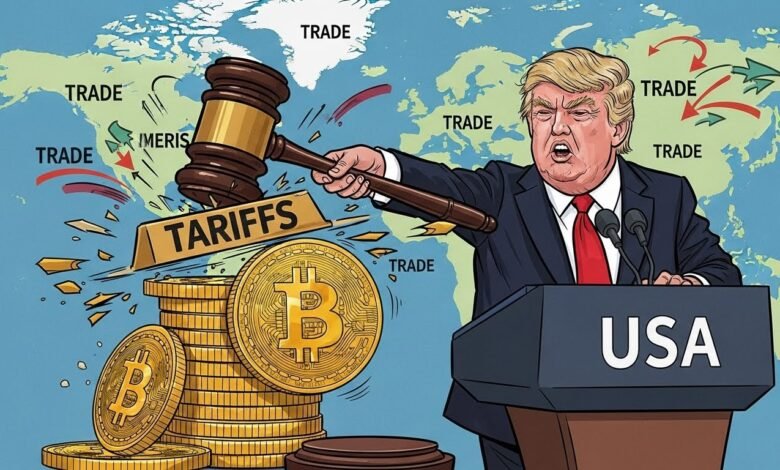
Trump’s tariffs on Bitcoin price dynamics have emerged as one of the most discussed topics among cryptocurrency investors and market analysts in 2025. While many assume that lifting tariffs would immediately benefit digital assets like Bitcoin, the reality presents a far more complex economic landscape that every crypto investor needs to understand.
The relationship between trade policy and cryptocurrency markets goes deeper than surface-level correlations. When examining how Trump’s tariffs affect Bitcoin price movements, we discover that the damage to Bitcoin’s valuation may extend well beyond the actual implementation period of these trade restrictions. This counterintuitive phenomenon stems from fundamental economic principles that affect risk assets across all markets, not just cryptocurrencies.
Understanding why Trump’s tariffs on Bitcoin price could persist even after policy reversals requires examining multiple economic factors, including inflation dynamics, investor sentiment, supply chain disruptions, and the broader macroeconomic environment that shapes cryptocurrency valuations. The crypto market’s sensitivity to these traditional economic forces has never been more apparent than during periods of significant trade policy uncertainty.
The Economic Ripple Effect of Tariff Policies on Cryptocurrency Markets
Trade restrictions create economic consequences that ripple through financial systems in ways that extend far beyond their immediate implementation. Trump’s tariffs and Bitcoin price illustrate how traditional economic policies continue influencing digital asset valuations long after the policies themselves change or disappear entirely.
When tariffs are imposed on major trading partners, the immediate impact involves increased costs for imported goods and materials. However, the secondary effects prove far more damaging to risk assets like Bitcoin. Businesses facing higher input costs often pass these expenses to consumers, triggering inflationary pressures throughout the economy. This inflation doesn’t simply vanish when tariffs get removed because price increases tend to become sticky, meaning businesses rarely reduce prices back to pre-tariff levels even when their costs decrease.
The Trump tariff’s impact on Bitcoin extends into how central banks respond to these inflationary pressures. When inflation rises above target levels, the Federal Reserve and other central banks typically maintain higher interest rates for extended periods. These elevated rates make traditional fixed-income investments more attractive relative to volatile assets like cryptocurrencies, leading investors to reallocate capital away from Bitcoin and similar digital assets.
Consumer spending patterns also undergo lasting changes during tariff periods. When households experience sustained price increases across multiple product categories, they naturally become more conservative with discretionary spending and investment decisions. This behavioral shift affects Bitcoin adoption and investment flows because cryptocurrency remains largely a discretionary investment choice for most participants rather than a necessity.
Why Lifting Tariffs Doesn’t Immediately Reverse Bitcoin Price Damage
The assumption that removing trade restrictions would quickly restore Bitcoin price levels overlooks several critical economic realities. Markets operate with complex lag effects where policy changes take considerable time to fully work through the economic system and influence asset prices.
Supply chain reconfiguration represents one major reason why Trump’s tariffs Bitcoin price damage persists post-removal. When tariffs force companies to reorganize their supply networks, moving manufacturing to different countries or establishing new supplier relationships, these structural changes don’t simply reverse overnight. The investments businesses make in building alternative supply chains create new cost structures that remain in place regardless of tariff status.
The cryptocurrency market reaction to trade policy uncertainty also creates momentum effects that extend beyond the immediate policy environment. When Bitcoin experiences significant price declines during tariff implementation periods, technical support levels break down and investor confidence erodes. Rebuilding this confidence and establishing new price floors requires time and consistently positive economic signals, not just the removal of the original negative catalyst.
Labor market adjustments further complicate the recovery timeline. Tariff-induced economic uncertainty often leads businesses to freeze hiring, reduce expansion plans, or implement workforce reductions. These employment effects create income pressures for potential Bitcoin investors that persist well after tariff removal because companies typically approach new hiring cautiously following periods of economic uncertainty.
Inflation Persistence and Its Effect on Bitcoin as a Risk Asset
The Trump tariff impact on Bitcoin connects directly to how these trade policies influence inflation expectations and actual inflation rates. While Bitcoin advocates often position the cryptocurrency as an inflation hedge, market behavior during recent inflationary periods reveals a more nuanced reality about how Bitcoin performs when inflation runs hot.
Historical data from 2022 and 2023 demonstrated that Bitcoin often traded more like a risk asset than an inflation hedge during periods of elevated consumer price growth. When inflation prompted aggressive Federal Reserve rate hikes, Bitcoin prices fell substantially alongside technology stocks and other growth-oriented investments. This pattern suggests that the Bitcoin market responds more to changes in monetary policy designed to combat inflation than to inflation itself.
The tariff effect on Bitcoin through the inflation channel becomes particularly problematic because tariff-induced inflation often proves more persistent than demand-driven inflation. While central banks can cool demand-driven inflation by raising interest rates, tariff-related cost-push inflation requires either policy reversal or supply-side adjustments that take much longer to materialize.
Businesses experiencing tariff-driven cost increases typically lock in these higher prices through multi-year contracts with suppliers and customers. Labor unions negotiate wage increases to compensate for higher living costs, and these wage gains get embedded in cost structures for years ahead. Real estate costs adjust upward to reflect higher construction materials prices. All these factors mean that even after tariffs get lifted, the inflationary impulse they created continues affecting the economy and keeping pressure on Bitcoin price levels.
How Trade Policy Uncertainty Reshapes Investor Risk Appetite
The cryptocurrency market demonstrates particular sensitivity to shifts in overall investor risk tolerance, making understanding the Trump’s tariffs Bitcoin price relationship crucial for anyone involved in digital asset markets. Trade policy uncertainty represents one of the most powerful forces capable of dramatically reducing investor willingness to hold volatile assets like Bitcoin.
When tariff policies create unpredictable economic conditions, institutional investors often implement risk-reduction strategies that involve decreasing exposure to assets with high volatility and uncertain regulatory futures. Bitcoin and other cryptocurrencies typically rank among the first asset classes that institutions scale back during such defensive positioning because they combine price volatility with ongoing regulatory uncertainty.
The Trump tariff cryptocurrency impact extends to retail investors as well, though through different psychological channels. Retail cryptocurrency holders often exhibit momentum-following behavior, becoming more willing to invest as prices rise and more likely to sell as prices decline. When tariff uncertainty triggers initial Bitcoin price weakness, retail selling pressure can amplify the decline through these psychological feedback loops.
Survey data consistently show that investor sentiment toward risk assets deteriorates during periods of trade policy uncertainty, regardless of whether people directly understand the economic mechanisms at work. This sentiment shift affects Bitcoin investment decisions because cryptocurrency purchases remain largely discretionary for most investors. When economic uncertainty rises, households naturally prioritize building emergency savings and reducing debt over speculative cryptocurrency investments.
The Dollar Strength Dynamic and Bitcoin Valuation
Understanding Trump’s tariffs and Bitcoin price dynamics requires examining how trade policies influence the US dollar’s value and how dollar strength affects cryptocurrency valuations. This relationship operates through multiple channels that often work simultaneously to pressure Bitcoin prices.
Tariff implementation typically strengthens the US dollar in the short term because foreign companies need more dollars to pay the tariff costs on goods they export to the United States. This initial dollar strength often coincides with Bitcoin price weakness because the cryptocurrency trades inversely to dollar strength in many market conditions. When the dollar appreciates, Bitcoin priced in dollars typically declines even if Bitcoin’s value remains stable in other currencies.
The longer-term dollar effects of tariff policies create additional complications for Bitcoin price levels. If tariffs successfully reduce US trade deficits by decreasing imports, the reduced international dollar supply could maintain elevated dollar values for extended periods. This sustained dollar strength would continue pressuring Bitcoin valuations long after the tariff policies themselves get modified or removed.
Central bank policy responses to tariff-induced economic changes further influence the dollar-Bitcoin relationship. When the Federal Reserve maintains higher interest rates to combat tariff-driven inflation, these elevated rates attract international capital flows into dollar-denominated assets, further strengthening the currency and creating headwinds for cryptocurrency markets.
Business Investment Cycles and Their Cryptocurrency Market Impact
The Trump tariff impact on Bitcoin manifests through changes in business investment patterns that affect the broader economic environment supporting cryptocurrency adoption and investment. Trade policy uncertainty causes businesses to postpone major investment decisions because companies naturally avoid committing capital during periods when future economic conditions remain unclear.
These delayed business investments reduce economic growth prospects, which subsequently affects Bitcoin price levels through multiple channels. Slower economic growth typically translates to reduced corporate profits, lower household income growth, and decreased consumer spending. All these factors reduce the discretionary income available for cryptocurrency investment while simultaneously making traditional defensive investments relatively more attractive.
Technology sector investments show particular sensitivity to trade policy uncertainty because many technology companies maintain complex global supply chains vulnerable to tariff disruptions. Since cryptocurrency adoption and blockchain technology development correlate strongly with overall technology sector health, trade policy impacts on tech investment indirectly influence Bitcoin market conditions.
The tariff effect on Bitcoin through business investment channels also operates through venture capital and private equity flows into cryptocurrency and blockchain companies. When trade uncertainty creates cautious investment environments, venture capital firms typically reduce allocations to speculative technology sectors including blockchain infrastructure and cryptocurrency platforms. This reduced capital availability affects the entire cryptocurrency ecosystem’s growth trajectory.
Consumer Confidence Deterioration and Discretionary Investment Patterns
Consumer confidence serves as a leading indicator for discretionary investment activity including Bitcoin investment decisions. The Trump’s tariffs Bitcoin price connection operates powerfully through consumer confidence channels because trade policy uncertainty directly affects how households perceive their economic futures.
Research consistently demonstrates strong correlations between consumer confidence levels and cryptocurrency market activity. When confidence measures decline, new account openings at cryptocurrency exchanges drop, trading volumes decrease, and existing holders become more likely to liquidate positions. These behavioral patterns mean that tariff-induced confidence deterioration translates directly into reduced demand for Bitcoin and downward pressure on prices.
The psychological impact of trade policy uncertainty on consumer behavior often exceeds the actual economic damage because uncertainty itself creates anxiety that influences spending and investment choices. Even households not directly affected by tariff-related price increases often reduce discretionary spending when broader economic uncertainty rises, and this precautionary behavior extends to cryptocurrency investment decisions.
Cryptocurrency market participation requires both available capital and psychological willingness to take investment risks. Trade policy uncertainty simultaneously reduces available capital through its economic effects while also decreasing psychological risk tolerance through confidence channels. This dual impact makes the Trump tariff cryptocurrency impact particularly significant for digital asset valuations.
Global Economic Growth Slowdowns and Bitcoin Price Correlations
The international nature of tariff policies means their economic effects extend far beyond US borders, creating global growth slowdowns that subsequently impact Bitcoin price levels. When the United States implements significant tariffs, affected trading partners often retaliate with their own trade restrictions, triggering cascading effects throughout the global economy.
These worldwide economic slowdowns affect Bitcoin because cryptocurrency markets demonstrate increasing correlation with global risk sentiment and international capital flows. The Trump tariff impact on Bitcoin amplifies during periods when tariff policies trigger broader international trade conflicts because these escalations create synchronized economic weakness across multiple major economies.
European and Asian cryptocurrency markets represent significant portions of total Bitcoin market activity, meaning economic weakness in these regions directly reduces global demand for digital assets. When tariff policies contribute to slowing growth in major economies outside the United States, the reduced purchasing power and investment capacity in these markets translates to decreased Bitcoin demand and lower equilibrium prices.
The timing lag between tariff implementation and global growth impacts further explains why Trump’s tariffs Bitcoin price effects persist after policy changes. International economic relationships operate with substantial lags, meaning tariff-induced trade disruptions continue affecting global growth trajectories for quarters or years after the original policies get modified or reversed.
The Employment Picture and Cryptocurrency Investment Capacity
Labor market conditions fundamentally influence Bitcoin investment capacity among retail investors who represent a substantial portion of cryptocurrency market participants. The Trump’s tariffs Bitcoin price relationship operates significantly through employment channels as trade restrictions affect job availability, wage growth, and income security.
When tariffs increase costs for import-dependent businesses, companies often respond by freezing hiring, reducing hours, or implementing layoffs to maintain profitability. These employment adjustments directly reduce the number of potential Bitcoin investors with surplus income available for speculative investments. The cryptocurrency market depends heavily on employed individuals with discretionary income, making it particularly vulnerable to employment weakness.
Wage growth patterns also shift during periods of tariff-induced economic uncertainty. Even workers who maintain employment often experience slower wage growth as companies face increased costs and reduced pricing power. This wage stagnation limits the income growth necessary to support increased cryptocurrency investment activity over time.
The gig economy workers and freelancers who comprise a growing portion of cryptocurrency enthusiasts face particular vulnerability to trade policy disruptions. These workers typically experience the first impacts of economic slowdowns through reduced demand for their services, and they also lack the income stability that makes cryptocurrency investment psychologically comfortable during uncertain times.
Technical Market Dynamics and Momentum Loss
The Bitcoin market demonstrates strong technical trading patterns that amplify fundamental economic impacts from policies like tariffs. Understanding these technical dynamics provides crucial context for comprehending why Trump’s tariffs Bitcoin price effects extend beyond the immediate policy period.
Cryptocurrency markets operate with significant algorithmic and technical trading activity where price movements trigger automated buy or sell orders based on technical indicators and chart patterns. When tariff policies initiate Bitcoin price declines that break through key technical support levels, these algorithmic systems often generate additional selling pressure that accelerates the downward movement regardless of fundamental conditions.
The Trump tariff impact on Bitcoin through technical channels becomes self-reinforcing because momentum indicators that drive many trading algorithms operate with lag periods. Even after the fundamental economic situation stabilizes or improves, negative momentum signals can persist for weeks or months, continuing to generate selling pressure that keeps prices depressed.
Options market positioning and futures market dynamics add additional layers to how technical factors extend tariff effects on Bitcoin beyond policy implementation periods. When traders establish large short positions during tariff-induced uncertainty, unwinding these positions requires time and often creates additional volatility that prevents rapid price recovery even after fundamental conditions improve.
Regulatory Attention and Cryptocurrency Policy Complications
Trade policy turbulence often coincides with increased regulatory scrutiny of cryptocurrency markets, creating an additional channel through which Trump’s tariffs Bitcoin price relationships manifest. When economic uncertainty rises due to tariff policies, regulators typically become more conservative and risk-averse across all policy domains, including cryptocurrency oversight.
The cryptocurrency market operates in an evolving regulatory environment where policy clarity remains incomplete across many jurisdictions. Economic stress from trade disruptions often prompts regulators to acceleratethe implementation of cryptocurrency restrictions or delay approval of pro-crypto policies that might otherwise advance during stable economic periods.
Congressional and executive branch attention naturally focuses on economic problems created by tariff policies during implementation periods, leaving less bandwidth and political capital available for cryptocurrency-friendly legislative initiatives. This attention deficit affects the Bitcoin market by stalling positive regulatory developments that could otherwise support price appreciation.
International regulatory coordination on cryptocurrency policies also suffers during periods of trade conflict because countries engaged in tariff disputes demonstrate less willingness to cooperate on unrelated policy matters. This regulatory fragmentation creates additional uncertainty that weighs on Bitcoin price levels by making it harder for global cryptocurrency businesses to operate efficiently across borders.
Long-Term Structural Changes to Investment Portfolio Allocation
The Trump’s tariffs on Bitcoin price extends into how the investment management industry approaches cryptocurrency allocations within diversified portfolios. Trade policy uncertainty prompts financial advisors and portfolio managers to reassess risk management frameworks in ways that often reduce recommended cryptocurrency exposures.
Modern portfolio theory emphasizes diversification across assets with different risk characteristics and return correlations. When tariff policies increase overall economic uncertainty and volatility across multiple asset classes simultaneously, the diversification benefits of including Bitcoin in portfolios decrease because correlations between Bitcoin and traditional risk assets tend to increase during stress periods.
This correlation shift affects Bitcoin investment flows from institutional sources because pension funds, endowments, and other large investors often have strict risk management guidelines that limit exposure to assets exhibiting high correlations with equity markets. The Trump tariff cryptocurrency impact includes pushing Bitcoin’s correlation with stocks higher during stress periods, potentially triggering mechanical reduction in institutional allocations.
Wealth management practices also evolve in response to sustained periods of economic uncertainty, with advisors typically becoming more conservative in their cryptocurrency recommendations following volatility events. These changed advisory practices persist well beyond the immediate uncertainty period as firms implement more stringent due diligence and risk assessment processes for digital asset recommendations.
The Path Forward: What Bitcoin Investors Should Monitor
Understanding Trump’s tariffs Bitcoin price dynamics requires ongoing attention to multiple economic indicators that signal whether tariff-related pressures on cryptocurrency markets are intensifying or moderating. Informed investors should track several key metrics to assess current market conditions and potential future developments.
Inflation data releases provide crucial information about whether tariff-induced price pressures are persisting or fading. Core inflation measures that exclude volatile food and energy prices offer the clearest signals about underlying inflation trends that influence Federal Reserve policy and subsequently affect Bitcoin price through interest rate channels.
Federal Reserve communications deserve close monitoring because central bank policy responses to tariff-driven economic changes often matter more for cryptocurrency markets than the tariff policies themselves. When Fed officials signal confidence that inflation is contained and rate cuts may be approaching, this typically supports Bitcoin market sentiment regardless of trade policy specifics.
Business investment statistics and manufacturing surveys indicate whether companies are regaining confidence to commit capital to growth initiatives. Improving business investment trends generally support cryptocurrency market conditions by suggesting economic conditions are stabilizing and growth prospects improving.
Consumer confidence surveys and retail sales data provide insights into household economic security and discretionary spending capacity. When these measures show sustained improvement, it typically signals that conditions are becoming more favorable for discretionary Bitcoin investment activity.
Strategic Considerations for Cryptocurrency Investors During Trade Policy Uncertainty
Navigating the Trump’s tariffs Bitcoin price relationship requires strategic thinking about position sizing, diversification, and timing decisions. Investors who understand the multiple channels through which trade policies affect cryptocurrency valuations can make more informed decisions about when to increase or decrease exposure.
Dollar-cost averaging strategies become particularly valuable during periods of trade policy uncertainty because they allow investors to gradually build Bitcoin positions without trying to perfectly time market bottoms. This approach helps mitigate the risk of investing heavily just before additional tariff-related sell-offs while ensuring participation if prices stabilize and begin recovering.
Diversification across different cryptocurrency assets may provide some protection because alternative cryptocurrencies sometimes demonstrate different sensitivity profiles to macroeconomic factors compared to Bitcoin. However, investors should recognize that major economic shocks from trade policy disruptions typically affect the entire cryptocurrency sector, limiting diversification benefits.
Maintaining adequate liquidity reserves allows investors to take advantage of price dislocations when tariff-induced uncertainty creates excessive pessimism in cryptocurrency markets. Having available capital to deploy during maximum fear periods requires discipline to hold cash even when prices are rising, but this patience often gets rewarded during volatile periods driven by policy uncertainty.
Conclusion
Successful cryptocurrency investors must recognize that Bitcoin market performance depends heavily on broader macroeconomic conditions that trade policies significantly influence. The simplistic assumption that lifting tariffs would quickly restore Bitcoin prices overlooks the complex economic relationships and market dynamics that determine cryptocurrency valuations over time.
Understanding these persistent Trump tariff cryptocurrency impact channels allows investors to maintain realistic expectations about recovery timelines and make more informed decisions about cryptocurrency allocations. Rather than expecting immediate price rebounds when trade policies shift, sophisticated investors prepare for extended periods where tariff-related economic damage continues influencing digital asset markets.
The key to navigating periods of trade policy uncertainty involves combining fundamental economic analysis with disciplined risk management approaches. By monitoring leading economic indicators, maintaining appropriate portfolio diversification, and avoiding excessive leverage or concentration in cryptocurrency positions, investors can position themselves to weather tariff-related volatility while remaining positioned to participate in eventual market recoveries.
For anyone involved in Bitcoin investment decisions, recognizing that Trump’s tariffs Bitcoin price relationships operate through multiple complex channels over extended timeframes represents essential knowledge for successful long-term outcomes. The intersection of trade policy and cryptocurrency markets will likely remain relevant for years ahead, making ongoing education about these dynamics a valuable investment in itself.
If you found this analysis helpful for understanding Trump’s tariffs and Bitcoin price dynamics, consider implementing the risk management strategies discussed and staying informed about economic indicators that signal changing conditions. The cryptocurrency market rewards investors who combine fundamental understanding with disciplined execution, particularly during challenging periods driven by macroeconomic and policy uncertainty.
See more;Bitcoin Price Surge Trump’s Remarks Spark 6% Jump to $93,800