
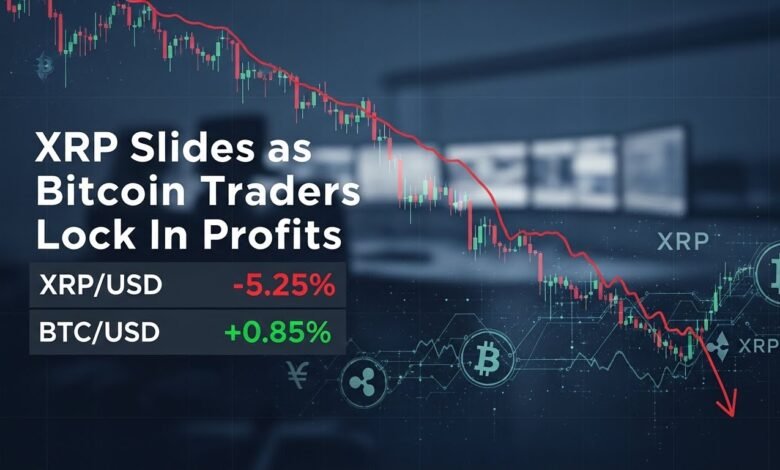
The XRP price has been under pressure recently, slipping from recent highs even as interest in the broader crypto market remains elevated. Traders are locking in Bitcoin profits after a historic run, and the resulting rotation and risk-off mood have weighed on alternative assets like XRP. At the same time, ETF inflows into both Bitcoin and XRP-linked products remain robust, sending a powerful mixed signal: short-term price weakness against a backdrop of growing institutional demand.
This apparent contradiction is what makes the current crypto market so fascinating. On one side, you have traders de-risking, taking profits on aggressive rallies and pushing XRP down toward recent support levels around the $2 region. On the other, you see record or near-record XRP ETF inflows, billions of dollars flowing into regulated exchange-traded products that are designed for longer-term exposure rather than quick speculation.
In this article, we will unpack why XRP slides even as ETF flows stay strong, how Bitcoin profit taking affects XRP, what the latest ETF data tells us about institutional sentiment, and what it could all mean for XRP’s medium-term outlook. You will also discover the key levels to watch, the role of regulation and macro conditions, and how traders are positioning around this unusual combination of price weakness and strong capital inflows.
XRP Price Slide: What Is Happening On The Charts?
The first piece of the puzzle is the XRP price action itself. After a strong rally earlier in the year, XRP has retreated, recently trading near six-week lows in the $2.10–$2.50 range. One widely cited market snapshot showed XRP dipping to around $2.12, down significantly from its mid-year highs and roughly 40% below its recent peak.
This pullback is not happening in isolation. It follows a sharp, broad-based crypto market correction in which Bitcoin, Ethereum, Solana, and XRP all sold off as investors rotated out of risk assets amid concerns about stretched valuations and uncertain central bank policy. In that sell-off, XRP registered one of the steeper daily drops, sliding nearly 9% in a single session.
Technical Picture: Support, Resistance, and Correlation
From a technical perspective, XRP is now oscillating around a key psychological level near $2. Analysts point out that this zone is acting as a crucial pivot: if the XRP price holds above it, a relief rally toward the $2.20–$2.45 region may follow, while a decisive break lower could open the door to deeper retracements. Some reports note that XRP is trading within a narrowing consolidation channel, with momentum indicators like RSI hovering in neutral territory, reflecting indecision rather than outright capitulation.
Another important factor is XRP’s growing correlation with Bitcoin. Recent market research highlighted that the XRP–Bitcoin correlation climbed to one of its highest levels of the year, meaning XRP tends to follow Bitcoin’s direction more closely than before. When Bitcoin is under pressure, that tighter relationship can accelerate selling in XRP, even if XRP-specific fundamentals remain constructive.
In other words, XRP’s slide is not purely about Ripple, cross-border payments, or token-specific narratives. It is also about macro liquidity, risk sentiment, and the behavior of large Bitcoin holders who dominate flows across the entire crypto ecosystem.
Bitcoin Profit Taking: How It Spills Over Into XRP
The second major piece is Bitcoin profit taking. After setting new record highs earlier in the year and then failing to extend gains, Bitcoin saw a notable wave of profit realization. High-profile Bitcoin ETFs, including flagship funds from major asset managers, recorded heavy single-day outflows as investors locked in gains accumulated during the rally.
From Bitcoin Gains to Altcoin Pressure
Profit taking in Bitcoin ETFs and spot markets has several knock-on effects for XRP:
When large investors derisk, they often sell both core holdings like Bitcoin and higher-beta assets such as XRP at the same time. That means even if XRP ETFs still see inflows, short-term selling on exchanges can pull the price down.
Bitcoin corrections tend to tighten financial conditions within crypto. When Bitcoin volatility spikes and prices fall, leveraged traders are forced to deleverage across multiple coins, which can trigger cascading liquidations in altcoins including XRP.
Portfolio managers rebalancing after a big Bitcoin rally may rotate some capital out of crypto entirely, reducing the net demand for alternative assets. Even small percentage reductions can matter when they occur simultaneously across hundreds of funds.
This dynamic explains why we can see XRP sliding even while the broader narrative around XRP’s use case and ETF landscape remains positive. It is not that investors have suddenly “given up” on XRP; rather, they are reacting to macro and Bitcoin-driven signals that dominate short-term trading.
The Paradox: XRP Slides While ETF Flows Stay Strong
Here is where things get interesting. Even as XRP’s spot price pulls back, data shows that ETF inflows remain robust, both for Bitcoin and especially for XRP-linked products. Recent reports highlight that global XRP exchange-traded products have absorbed hundreds of millions of dollars in a matter of days, with nearly 330 million XRP locked up over a short period.
In the United States alone, several spot XRP ETFs and ETPs have launched or expanded, attracting hundreds of millions in assets under management and gathering net inflows that, on some days, outpaced Bitcoin and Ethereum products. One analysis noted that XRP ETFs collected substantially larger net inflows than their Bitcoin counterparts on specific trading days, even as Bitcoin retains a much bigger overall asset base.
Capital flowing into ETFs is often “stickier” than speculative exchange buying. Funds that allocate to XRP ETFs are typically making a multi-month or even multi-year allocation, not a leveraged day trade. That makes ETF flows a powerful indicator of medium-term conviction in the XRP investment thesis, even when short-term price action looks shaky.
Institutional Sentiment: What Flows Are Telling Us
Institutional data from multiple research desks and fund tracking services paints a consistent picture: while Bitcoin still dominates total assets under management, XRP ETF inflows have been punching above their weight. One recent round of weekly figures showed Bitcoin ETFs bringing in hundreds of millions of dollars in net inflows, while XRP funds ranked near the top of all altcoins, capturing a substantial share of new money entering crypto through regulated products.
Another dataset underscored that XRP ETFs, in aggregate, have occasionally overtaken Bitcoin and Ethereum ETFs in net inflow velocity, particularly around the launch of new XRP products. On some days, net inflows into XRP-linked funds were multiple times those of Bitcoin, highlighting a clear rotation of institutional interest toward Ripple’s ecosystem.
LSI Signals: Beyond Raw Numbers
Looking beyond the headline numbers, several LSI-style indicators help interpret what this means for XRP:
Rising assets under management (AUM) in XRP funds: Higher AUM suggests that capital is not just passing through but staying invested.
Growing global access to XRP products: More exchanges and jurisdictions listing XRP ETPs indicates regulatory comfort and deeper market penetration.
Sustained net ETF inflows even during price corrections: When investors buy dips via ETFs, it hints at a strategy of accumulation rather than panic selling.
Taken together, these institutional flows tell a story that is more bullish than a simple price chart might suggest. While short-term traders push the XRP price down, longer-term capital appears to be steadily building positions.
Trader Psychology: Fear, Rotation, and Opportunity
To truly understand why XRP slides while ETF flows stay strong, we need to look at trader psychology on different time scales.
Short-term crypto traders are highly sensitive to volatility, news headlines, and derivatives funding rates. When they see Bitcoin rolling over after a parabolic run, their instinct is to protect capital, close leveraged positions, and move to cash or stablecoins. This wave of de-risking naturally affects XRP trading pairs, contributing to sell pressure even if the long-term story has not changed.
Institutional investors, on the other hand, think in terms of quarters and years rather than days. They may view pullbacks in XRP and Bitcoin as opportunities to deploy fresh capital into ETFs at more attractive valuations. For them, stronger regulatory clarity around XRP, the maturing of its cross-border payments narrative, and the presence of large, liquid ETFs can make dips appealing entry points rather than reasons to panic.
This creates the paradox we see now: frenetic spot market selling driven by short-term fear, coexisting with steady, methodical ETF buying driven by long-term conviction.
Macro and Regulation: The Bigger Forces Behind XRP Moves
The performance of XRP, Bitcoin, and ETF flows cannot be separated from macroeconomic and regulatory forces.
On the macro side, shifting expectations around interest rate cuts, inflation, and economic growth periodically push investors away from speculative assets. When markets doubt that central banks will ease policy soon, risk assets such as cryptocurrencies face headwinds. That was part of the story behind the recent broad crypto correction that pulled XRP down.
On the regulatory side, however, the trend has been more supportive for XRP. Multiple jurisdictions have either clarified XRP’s legal status or allowed the launch of XRP ETPs and ETFs, signaling increasing comfort with the asset at an institutional level. The debut of the first U.S.-listed XRP ETF, for example, saw record opening-day volume, even though short-term profit taking quickly overshadowed the headline.
This combination—macro uncertainty but regulatory progress—helps explain why the XRP price can be soft while ETF inflows are firm. Long-term investors care more about regulatory clarity and product availability, while short-term traders are dominated by macro fear and volatility.
Key Levels and Scenarios: What Could Happen Next for XRP?
Looking ahead, XRP’s trajectory will likely be shaped by the tug-of-war between on-chain sentiment, macro conditions, and ETF flows.
If the $2 support zone continues to hold and Bitcoin stabilizes, XRP could see a relief rally as short sellers cover and dip buyers step in. Technical analysis suggests that a move above short-term moving averages in the low-$2 range could open a path to retest higher resistance near $2.30–$2.50 and eventually challenge the psychologically important $3 region again.
On the other hand, if Bitcoin experiences another leg down, amplified by renewed profit taking in Bitcoin ETFs, XRP’s tight correlation could drag it below support, forcing the market to search for a new equilibrium at lower levels. In that scenario, ETF inflows might slow temporarily, but as long as they do not reverse into persistent outflows, the medium-term story of accumulation and institutional interest in XRP remains intact.
Ultimately, the balance of evidence suggests that XRP’s recent slide is more a symptom of broader crypto market volatility and Bitcoin-driven de-risking than a fundamental collapse in the XRP thesis. Strong and continuing ETF flows, growing global product availability, and sustained institutional interest point to a market that is repricing risk in the short term but still quietly building positions for the long term.
Conclusion
XRP’s recent price slide, occurring while traders take Bitcoin profits and rotate out of risk, might look worrying at first glance. In reality, it reflects a familiar cycle in crypto: parabolic rallies, profit taking, and short-term volatility that can obscure deeper structural trends.
Beneath the surface, ETF inflows remain strong for both Bitcoin and XRP, with some data showing XRP-linked products outperforming in net flows and assets under management growth. Institutional investors, wealth managers, and long-term allocators are using regulated XRP ETFs to gain exposure, even as retail and leveraged traders flush out during bouts of volatility.
For traders and investors, the key is to recognize the difference between short-term noise and long-term signals. Spot prices and funding rates capture daily fear and greed; ETF flows, regulatory progress, and global adoption capture strategic conviction. At the moment, these long-term signals suggest that while XRP slides in the short term, the foundation for a potential future recovery—and perhaps eventual outperformance versus Bitcoin—remains in place.
If you track XRP, this is a time to watch the $2 support zone, monitor Bitcoin ETF flows, and pay close attention to how XRP ETFs behave in the face of market stress. The stronger those flows remain during volatility, the clearer the message: some of the smartest money in the market is not fleeing XRP; it is quietly accumulating.
FAQs
Q; What is causing XRP to slide even though ETF flows are strong?
XRP is sliding primarily because the broader crypto market has been under pressure and traders are taking Bitcoin profits after a strong rally. When Bitcoin corrects, leveraged positions across altcoins tend to unwind, dragging down the XRP price as well. At the same time, XRP ETFs continue to attract capital from institutional investors who have a longer time horizon and are not reacting to every short-term dip. This creates a situation where spot prices fall while regulated products still receive inflows.
Q; How do Bitcoin profits affect the XRP price?
When Bitcoin experiences a big rally followed by profit taking, it often triggers a generalized de-risking across cryptocurrencies. Large traders and funds that hold both Bitcoin and XRP may sell portions of both to lock in gains and reduce exposure. Additionally, Bitcoin-driven corrections can increase volatility, prompt margin calls, and force leveraged liquidations, which all add to selling pressure in altcoins like XRP. Because XRP’s correlation with Bitcoin has climbed, this spillover effect has become even stronger.
Q; Why are ETF inflows considered bullish for XRP?
ETF inflows are considered bullish because they represent fresh capital entering regulated investment vehicles that are usually used for medium- to long-term exposure. When XRP ETFs consistently receive net inflows, it suggests that institutions, advisors, and long-term investors see value in holding XRP despite short-term volatility. Rising assets under management in these funds indicate that capital is staying invested rather than simply trading in and out, which supports the idea of gradual accumulation and underlying confidence in XRP’s future.
Q; Can XRP recover if Bitcoin remains volatile?
XRP can recover even if Bitcoin remains volatile, but the path is likely to be uneven. As long as XRP maintains key technical support levels and continues to attract institutional inflows through ETFs and other products, it has a solid foundation for eventual upside. However, strong negative shocks in Bitcoin often ripple through the entire market, and XRP is not immune to those moves. A more stable or slowly rising Bitcoin environment would make an XRP recovery smoother, but strategic adoption, regulatory clarity, and ongoing ETF demand give XRP room to perform even amid choppy conditions.
Q; Is now a good time to invest in XRP while it is sliding?
Whether it is a good time to invest in XRP depends on your risk tolerance, time horizon, and overall portfolio strategy. The current environment, where XRP slides in price while ETF inflows remain strong, suggests that long-term investors are using weakness as an opportunity to build positions. However, the same volatility that creates opportunity also adds risk, especially for short-term traders. If you are considering exposure to XRP, it is wise to understand the macro backdrop, the link between XRP and Bitcoin, the role of XRP ETFs, and the key support levels on the chart, and to size your position accordingly within a diversified portfolio.