
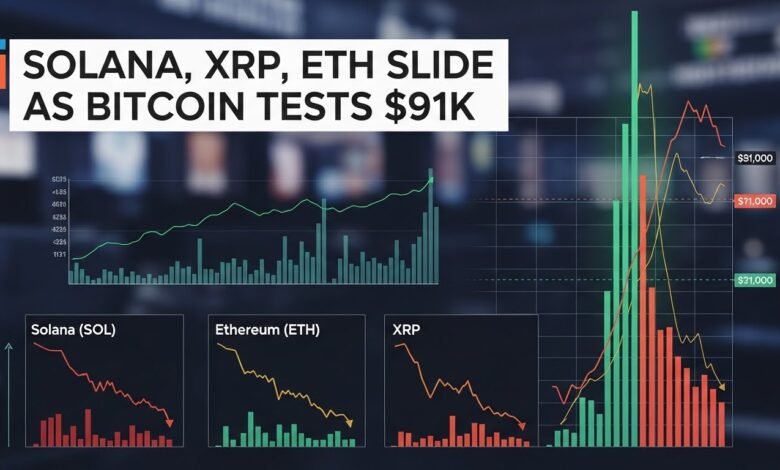
The crypto market has slipped back into risk-off mode. After an explosive run that pushed Bitcoin to six-figure territory, selling pressure has returned, dragging major altcoins like Solana (SOL), XRP, and Ethereum (ETH) lower. At the center of the story is one number: Bitcoin’s $91,000 support zone.
This level has emerged as a key battlefield between bulls and bears. Analysts and traders are watching it closely, not only because it marks a major technical area, but because a decisive move below it could accelerate losses across the broader crypto market, while a strong bounce could revive bullish sentiment and fuel the next leg higher. Recent market updates show Bitcoin oscillating around the low $90,000 region, with multiple reports highlighting how traders are treating the $90,000–$91,000 band as a pivotal support range.
At the same time, Solana, XRP, and ETH have extended their losses, underperforming after earlier rallies. News coverage points to a mix of profit-taking, macro headwinds, ETF flow dynamics and large-scale liquidations as the main catalysts.
Here is the current Bitcoin price snapshot for quick context:
With Bitcoin now fighting to defend critical support and altcoins slipping, traders are asking the same questions: Is this just another crypto market correction, or the start of a deeper downtrend? And what does it mean specifically for Solana, XRP, ETH, and the broader risk landscape?
In the sections below, we break down the situation in detail, explore the latest on-chain and macro narratives, and look at potential scenarios as Bitcoin’s $91K support comes back into focus.
Why Bitcoin’s $91K Support Matters So Much
The $91,000 region has become a psychological and technical magnet for the market. After Bitcoin’s surge to fresh all-time highs, price action has carved out a series of lower highs, hinting at fading momentum and a maturing trend. Analysts now describe the short-term structure as a choppy pullback within a broader uptrend, with the $90,000–$91,000 area acting as a key decision zone.
From a technical perspective, this Bitcoin price support region matters for several reasons. First, it aligns with previous consolidation zones where buyers aggressively stepped in earlier in the cycle. Second, many leveraged traders and institutional participants have stop levels, hedges, or rebalancing triggers clustered around these prices. A clean breakdown could spark another wave of liquidations, just as previous corrections erased more than a billion dollars in long positions in a single day.
On the other hand, a convincing bounce from $91K would signal that long-term holders and new buyers are willing to defend the trend. Historically, when Bitcoin manages to hold major support after a blow-off top, it often transitions into a more sustainable phase where volatility compresses before the next large move. As a result, this zone is not just a line on the chart; it is a test of market conviction, risk appetite and confidence in Bitcoin’s role as the flagship digital asset.
Market Sentiment: Risk-Off Mood and ETF Flow Dynamics
Beyond charts, fund flows show a clear cooling of enthusiasm. Spot Bitcoin ETFs and Ether ETFs have recorded multi-day outflows, with hundreds of millions of dollars leaving major products as investors lock in gains and step back from risk.
This rotation reflects a more defensive stance. After months of strong inflows, some institutional players are trimming exposure, citing macro uncertainty, interest-rate expectations and concerns about overheated valuations. These outflows put additional pressure on Bitcoin and Ethereum prices, especially when they coincide with leveraged unwinds on derivatives exchanges.
Interestingly, Solana ETFs have not moved in lockstep. For a while they showed steady inflows even as Bitcoin and Ether products struggled, underlining growing institutional interest in high-beta altcoins and Solana’s ecosystem.
However, that resilience has limits. Recent data shows Solana products also experiencing patchy outflows as the price of SOL retreats. At the same time, XRP ETFs have attracted attention for their streak of consecutive inflow days, suggesting a subset of investors is using the pullback in XRP price as an opportunity to accumulate exposure.
The overall message from flows is clear: the market is not in full-on panic, but it is in a more cautious, risk-managed phase, where traders are quick to de-risk when volatility spikes and technical levels break.
Solana Extends Losses: From Market Darling to Volatile High-Beta Play
Solana has been one of the standout performers of this cycle, benefiting from its reputation as a high-throughput, low-fee chain and from waves of retail enthusiasm around memecoins, DeFi, and NFT projects built on its network. During Bitcoin’s push to new highs, Solana price often outpaced BTC on the way up, making it a favorite for traders seeking leverage to market sentiment.
That same high-beta profile now cuts the other way. As Bitcoin struggles and risk appetite cools, SOL has extended its losses, giving back a sizable chunk of its recent gains. Analysts point out that Solana remains structurally strong in the long term, with vibrant on-chain activity and continued developer interest, but short-term price action has clearly flipped from euphoria to corrective mode.
Several factors are weighing on Solana in this environment. First, profit-taking from early buyers and whales creates persistent overhead supply. Second, as volatility rises, some traders rotate out of more volatile names into relatively “safer” large caps like Bitcoin and Ethereum. Third, macro concerns and ETF outflows undermine the broader risk-on narrative, leading to faster drawdowns in altcoins that previously ran hottest.
Even so, Solana’s ecosystem metrics tell a more nuanced story. On-chain usage, DeFi volumes, and new token launches remain active, suggesting that the fundamental narrative has not collapsed. As a result, many market participants now view the current Solana correction as a test of conviction rather than a verdict on the chain’s long-term viability.
XRP Under Pressure Despite ETF Buzz
XRP has had a complicated year, balancing legal clarity in key jurisdictions, growing institutional interest and new XRP ETF launches on one side, and patchy price performance on the other. Recent reports show that XRP-themed ETFs have seen steady inflows, with cumulative net volumes in the hundreds of millions of dollars, even as spot prices struggle to break above important resistance zones.
Yet in the latest market down-leg, XRP price has extended its losses alongside other majors. Macro jitters, Bitcoin’s wobbling above and below $91K, and a broader crypto market sell-off have dragged XRP lower, overshadowing the otherwise positive narrative around regulated investment products and institutional adoption.
The divergence between ETF inflows and spot price action highlights a key theme: not all buying pressure is visible in the day-to-day chart. While speculative traders are quick to exit during volatility spikes, longer-horizon investors using ETFs may be quietly building positions, treating each dip as a chance to increase exposure at better prices.
From a technical standpoint, XRP remains capped beneath major resistance levels, and recent rallies have been sold into before they could morph into a sustained trend. For bulls, the path forward likely requires two ingredients working together: a stabilization in Bitcoin price above key support, and a fresh catalyst specific to the XRP ecosystem, such as new partnerships, payment corridors, or regulatory milestones.
Ethereum Slides but Holds Key Structural Role
Amid the noise around meme coins and high-beta plays, Ethereum continues to sit at the center of the smart contract and DeFi universe. Nonetheless, ETH has not been immune to this latest downturn. Markets have seen ETH extend losses as traders de-risk and Bitcoin struggles to maintain its higher levels.
Spot ETH price has faced pressure from several directions. ETF outflows reflect reduced risk appetite, while technical signals, including “death cross” patterns on some timeframes, have dampened short-term sentiment despite ETH managing to reclaim and defend the $3,000 level at times.
Yet Ethereum’s on-chain fundamentals still appear robust. Layer-2 networks continue to grow, staking participation remains high, and the ecosystem is deeply entrenched in areas like decentralized exchanges, NFTs, and tokenized real-world assets. Many long-term investors see current weakness as part of a normal cycle, where Ethereum corrections often shake out leveraged players before the next wave of use-case driven demand.
Ultimately, for ETH, the direction of Bitcoin’s $91K support test matters just as much as any ETH-specific narrative. Historically, major Ethereum rallies have often followed or coincided with renewed Bitcoin strength, as capital rotates from BTC into large-cap altcoins once traders gain confidence in the broader uptrend.
Liquidations, Leverage and the Mechanics of the Sell-Off
To fully understand why Solana, XRP, ETH extend losses while Bitcoin wrestles with $91K, it is important to look at the mechanics behind the corrections. Derivatives data shows repeated waves of long liquidations across Bitcoin, Ether and Solana markets whenever key levels give way. One recent episode wiped out over a billion dollars in bullish bets within 24 hours, with long traders making up the vast majority of liquidations.
This is classic crypto leverage flushing. During strong uptrends, traders pile into perpetual futures and margin positions, often with high leverage. As price grinds higher, these positions seem “safe,” encouraging even more risk-taking. But once the trend stalls and the first major support breaks, forced selling kicks in. Liquidations push prices down further, which triggers more liquidations, creating a cascading effect.
Altcoins like Solana, XRP, and ETH often suffer more during these events because they are typically more volatile and thinner in liquidity compared to Bitcoin. When liquidations hit, order books can thin out quickly, leading to sharper percentage losses even if the dollar value of liquidations is smaller than in BTC.
Once leverage is flushed out, markets can become healthier. Volatility may remain elevated, but price action begins to be driven more by genuine spot demand, ETF flows, and fundamental developments rather than purely speculative funding dynamics. For patient investors, this phase can offer opportunities to build longer-term positions in high-quality crypto assets at more reasonable valuations.
Macro Backdrop: Why Traditional Markets Still Matter
Even in a world obsessed with on-chain data and ETF flows, the macro backdrop remains a critical driver of crypto performance. Recent corrections have unfolded against a backdrop of shifting expectations around interest rates, inflation and global growth. Tighter liquidity conditions and hawkish central bank signals tend to reduce appetite for high-volatility, high-beta assets such as Bitcoin and altcoins.
When real yields rise and safe assets become more attractive, some institutional investors rebalance away from speculative segments of the market. This does not mean they lose faith in the long-term thesis of digital assets, but it does affect the timing and size of their allocations. At the same time, equity market volatility, particularly in high-growth tech, can spill over into the crypto space as the same investor base reassesses risk across their portfolios.
For Solana, XRP, ETH, and the rest of the market, this means that price action is shaped by more than just protocol upgrades or ecosystem news. Whether Bitcoin holds or loses $91,000 will be interpreted through the lens of macro sentiment: is this a healthy pullback in a risk-on environment, or a sign that global investors are stepping away from speculative assets for a while?
What Traders Are Watching Next
With volatility elevated and narratives shifting day to day, traders are focusing on several key signposts as Bitcoin’s $91K support returns to center stage.
First, they are tracking whether BTC can consistently hold above the $90,000–$91,000 zone and reclaim moving averages that currently sit overhead. A sustained move back toward six figures would likely restore confidence and reduce selling pressure in Solana, XRP, and ETH, opening the door for a renewed altcoin rotation.
Second, ETF flow data has become a real-time sentiment barometer. Continued Bitcoin and Ether ETF outflows would suggest lingering caution, while a flip back to consistent inflows could hint that large players view the current levels as attractive entry points. The behavior of Solana and XRP ETFs is equally important, as it reveals how allocators are positioning within the altcoin segment.
Third, traders watch for signs of stabilization in derivatives markets: declining funding rates, reduced open interest, and fewer liquidation spikes. These are all signs that the leverage reset is progressing and that spot buyers may soon have more influence over price than leveraged speculators.
Conclusion
The current environment is a textbook example of how tightly interconnected the crypto market really is. Solana, XRP, and ETH have extended losses, not in isolation, but in response to a broader shift in sentiment as Bitcoin tests the strength of its $91K support. ETF outflows, macro headwinds, leverage flushes and technical breakdowns have combined to create a challenging backdrop for risk assets.
Yet beneath the volatility, the structural trends that powered this cycle have not disappeared. Solana continues to host a vibrant high-throughput ecosystem. XRP is slowly building out its regulated investment and payments footprint. Ethereum remains the backbone of DeFi, NFTs, and Web3 infrastructure. For long-term participants, the key question is less about whether prices dip in the short run and more about whether the underlying networks continue to grow in usage, developer interest and real-world relevance.
For now, all eyes stay on Bitcoin. Hold $91,000, and the market may treat this as a healthy reset before the next leg higher. Lose it decisively, and the path of least resistance for Solana, XRP, ETH, and other major altcoins could be lower before any sustainable recovery begins.
In other words, this is a moment that demands both caution and clarity. Traders must respect the risks of leverage and rapid volatility, while investors must decide whether the current crypto market correction is a threat to avoid or an opportunity to carefully accumulate.
FAQs
Why are Solana, XRP, and ETH extending losses right now?
Solana, XRP and Ethereum are extending losses mainly because market sentiment has turned more cautious as Bitcoin struggles to hold the $90,000–$91,000 support zone.
What makes Bitcoin’s $91K level so important for the crypto market?
Bitcoin’s $91K area is important because it intersects psychological round-number significance with strong historical trading activity and technical support. Many traders have stop-losses, hedges and strategy rules that reference this band, so a break below often leads to accelerated liquidations and volatility.
How do ETF flows affect Solana, XRP, and Ethereum prices?
ETF flows act as a window into institutional and professional investor behavior. Sustained inflows into Bitcoin, Ethereum, Solana or XRP ETFs typically support prices by signaling fresh demand and by absorbing part of the available supply.
Is this just a normal crypto correction or the start of a bear market?
At this stage, the move looks more like a sharp but typical crypto correction rather than a confirmed long-term bear market. Corrections of 20 to 40 percent are common in digital asset cycles, especially after parabolic advances.
What should traders and investors focus on during this volatility?
Traders should focus on risk management above all, paying close attention to position sizing, leverage levels and key technical zones such as Bitcoin’s $91K support band.
See more; Crypto Market Crash $400M Liquidations Hit Bitcoin, ETH