
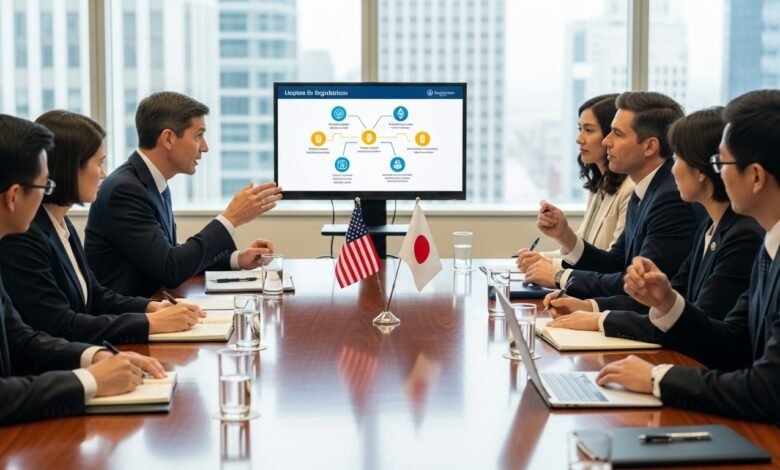
The global cryptocurrency landscape is evolving faster than most governments can keep pace with — but two of the world’s most powerful financial regulators are making a concerted effort to stay ahead. In a landmark development for digital finance, US and Japan crypto oversight talks have entered a new, more formal phase, with high-level officials from both nations convening to coordinate regulatory frameworks, share surveillance intelligence, and align policy standards. These bilateral discussions signal a major shift in how international regulators approach the governance of digital assets, moving away from isolated national policies toward collaborative, cross-border enforcement. As cryptocurrencies continue to transcend geographic boundaries, the urgency of this kind of coordinated regulatory diplomacy has never been greater. This article explores what these talks mean for the future of crypto regulation, what each nation brings to the table, and why the rest of the world is watching closely.
Why US and Japan Crypto Oversight Talks Matter for Global Markets
When the United States and Japan sit down to discuss financial policy, markets pay attention. Together, these two economies represent a combined GDP of over $27 trillion and are home to some of the most active cryptocurrency trading ecosystems on the planet.
Both nations have recognized that unilateral regulatory efforts are insufficient in an era where a single transaction can cross dozens of jurisdictions in milliseconds.
For Japan, which has historically been one of the most progressive nations in cryptocurrency compliance regulation — having legally recognized Bitcoin as a form of payment back in 2017 — these talks represent an opportunity to export its regulatory expertise to its most important ally. For the United States, which has faced years of internal disagreement between the SEC, CFTC, and FinCEN over who controls digital asset regulation, the talks offer a chance to benchmark against a more unified system.
The Strategic Context Behind the High-Level Diplomatic Engagement
A Relationship Built on Financial Trust
The US-Japan financial relationship is one of the most deeply institutionalized in the world. From their decades-long cooperation on traditional banking standards to joint participation in the Financial Action Task Force (FATF), both nations share a common philosophy: that robust, transparent financial oversight creates stability and attracts long-term investment. Extending that philosophy to crypto regulatory frameworks is a natural progression.
These high-level strategic talks on crypto did not emerge in a vacuum. They follow a series of international incidents — including the collapse of major crypto platforms, high-profile hacking events targeting Japanese exchanges, and growing concerns about crypto being used to evade sanctions — that have underscored the need for a coordinated global response. The conversations between US and Japanese officials are being framed not just as a compliance exercise, but as a matter of national financial security.
The Role of the FSA and US Regulatory Bodies
Japan’s Financial Services Agency (FSA) is widely regarded as one of the most sophisticated crypto regulatory bodies in the world. After the infamous 2018 Coincheck hack — in which over $530 million worth of cryptocurrency was stolen — the FSA undertook a sweeping overhaul of its digital asset oversight mechanisms. Today, Japanese crypto exchanges operate under strict licensing requirements, mandatory cold storage protocols, and rigorous customer protection standards.
On the American side, the conversation involves multiple agencies. The Securities and Exchange Commission (SEC) has been aggressively pursuing enforcement actions against crypto firms it deems to be operating unregistered securities offerings. The Commodity Futures Trading Commission (CFTC) asserts jurisdiction over crypto derivatives. Meanwhile, the Treasury Department’s FinCEN enforces AML compliance in the digital asset space. The challenge for the US has always been coordination — and the Japan model, with its centralized FSA authority, offers an instructive contrast.
Key Issues Being Addressed in the US and Japan Crypto Oversight Talks
Stablecoin Regulation and Systemic Risk
One of the most pressing items on the bilateral agenda is stablecoin regulation. The collapse of TerraUSD in 2022 sent shockwaves through both American and Japanese markets, wiping out billions in value and triggering urgent calls for regulatory intervention. Both nations are now developing legislative frameworks to govern stablecoins, and there is strong mutual interest in ensuring these frameworks are compatible.
Japan passed its stablecoin legislation in 2022, becoming one of the first G7 nations to create a clear legal framework for yen-pegged and foreign currency-pegged digital tokens.
Anti-Money Laundering and Sanctions Enforcement
Crypto AML compliance is another critical focus. Both the US Treasury and Japan’s FSA have flagged North Korean state-sponsored hackers — particularly the Lazarus Group — as a major threat to cryptocurrency exchange security. These actors have stolen billions in digital assets that are subsequently laundered through complex blockchain transactions. Sharing intelligence and coordinating sanctions enforcement is therefore a top priority.
The FATF’s “Travel Rule,” which requires virtual asset service providers (VASPs) to share customer information during transactions above certain thresholds, is a key point of alignment. Japan has implemented the Travel Rule through its own regulatory updates, while the United States is still working toward full VASP compliance. Bridging this gap is essential to making bilateral crypto policy enforcement effective.
Decentralized Finance and Regulatory Gaps
Perhaps the most complex challenge discussed in these talks is the oversight of decentralized finance (DeFi). Unlike centralized exchanges, DeFi protocols operate through self-executing smart contracts with no central authority — making traditional compliance frameworks difficult to apply. Both the US and Japan are grappling with how to regulate DeFi platforms without stifling innovation.
Discussions are reportedly exploring models that would hold developers and front-end interface operators accountable, even when the underlying protocol is decentralized. This is a philosophically significant departure from earlier regulatory thinking, and it reflects a growing consensus that global crypto governance cannot afford to leave DeFi in a permanent regulatory gray zone.
How These Talks Fit into the Broader G7 and International Crypto Policy Landscape
The US-Japan dialogue does not exist in isolation. It is part of a broader wave of G7 crypto policy coordination that has accelerated in recent years. The G7 nations — which include the US, Japan, UK, Germany, France, Italy, and Canada — have collectively called for stronger global standards on digital asset regulation, particularly following the turbulence of 2022 and 2023 in crypto markets.
Japan’s FSA has been an active participant in FSB working groups, and the US Treasury has contributed significantly to the IMF’s crypto risk assessment work. These multilateral inputs are feeding directly into the bilateral US-Japan discussions.
What makes the US and Japan crypto oversight talks particularly significant in this context is their specificity. While G7 statements tend to be broad in principle, bilateral negotiations can get into the granular details — specific exchange listing standards, blockchain analytics tools, joint investigation protocols, and mutual legal assistance mechanisms. This operational depth is what could make these talks transformative rather than merely symbolic.
Japan’s Competitive Advantage in Crypto Regulation
A Track Record of Proactive Oversight
Japan’s position as a crypto regulatory pioneer gives it a unique standing in these negotiations. The country has lived through some of the most dramatic failures in crypto history — from the Mt. Gox collapse in 2014 to the Coincheck hack in 2018 — and has emerged with a stronger, more resilient regulatory system as a result. That experience is invaluable.
Japanese regulators have developed sophisticated tools for monitoring exchange solvency, tracking suspicious transactions, and responding rapidly to security incidents. The FSA’s “sandbox” system also allows innovative digital asset companies to test new products in a controlled regulatory environment before seeking full licensure.
Web3 and the National Crypto Strategy
Japan has also positioned itself as a global hub for Web3 development, with explicit government support for blockchain-based innovation. Prime Minister initiatives have encouraged major Japanese corporations to explore tokenization, NFTs, and digital asset infrastructure. This creates an interesting dynamic in the regulatory talks: Japan is simultaneously one of the strictest regulators and one of the most enthusiastic government supporters of crypto technology. That combination of credibility gives Japan significant leverage in shaping global crypto governance standards.
What the United States Brings to the Table
The United States, despite its regulatory fragmentation, brings unparalleled market depth and enforcement power. American crypto exchanges and platforms represent the largest pools of trading liquidity in the world.
The US also has the world’s most sophisticated blockchain analytics infrastructure. Firms like Chainalysis and Elliptic, which work closely with US law enforcement, have developed tools capable of tracing crypto AML evasion across dozens of blockchains. Sharing these capabilities with Japan’s FSA as part of the bilateral crypto policy framework could significantly enhance both nations’ ability to combat financial crime.
Furthermore, the United States’ influence over the global financial system through the dollar and its dominance in international banking gives American crypto regulatory decisions an outsized impact on global norms. When the US moves toward a clearer framework — as these talks may help catalyze — the rest of the world tends to follow.
The Road Ahead: What to Expect from US-Japan Crypto Cooperation
Formal Memoranda and Joint Enforcement
Observers familiar with the talks expect them to eventually produce formal memoranda of understanding (MOUs) between the relevant agencies — likely between the SEC, CFTC, FinCEN, and Japan’s FSA. These MOUs would establish protocols for information sharing, joint investigations, and mutual recognition of certain compliance standards. Similar MOUs already exist between the US and Japan in traditional securities markets.
Legislative Alignment
In the US, several bipartisan bills are working through Congress — including comprehensive market structure legislation and stablecoin bills. Aligning the intent of these laws, even if their exact provisions differ, will be a key outcome of the bilateral dialogue.
Setting a Global Standard
Perhaps the most consequential long-term outcome of these talks is the potential to set a global standard for crypto regulatory frameworks. When two G7 nations with deep financial ties and decades of regulatory cooperation align their approaches to digital assets, it creates a powerful gravitational pull. Smaller economies often model their financial regulations on those of the US and Japan — meaning the norms established in these bilateral talks could effectively become the de facto global standard for cryptocurrency compliance.
Conclusion
The US and Japan crypto oversight talks represent one of the most consequential developments in the history of digital asset regulation. By combining Japan’s proactive regulatory experience with America’s market dominance and enforcement power, these two nations have the potential to create a bilateral framework that protects investors, deters financial crime, and still leaves room for innovation to flourish.
For anyone operating in the cryptocurrency space — whether as an investor, developer, exchange operator, or policymaker — understanding the direction of these talks is not optional. It is essential.
Stay informed, stay compliant, and engage with the emerging crypto regulatory framework before it fully takes shape. If you are a business or investor navigating this evolving landscape, now is the time to consult with legal and compliance experts who specialize in digital asset regulation across US and Japanese jurisdictions. See more; DOGEBALL Crypto Presale 2026: Claim 75% Bonus Now