
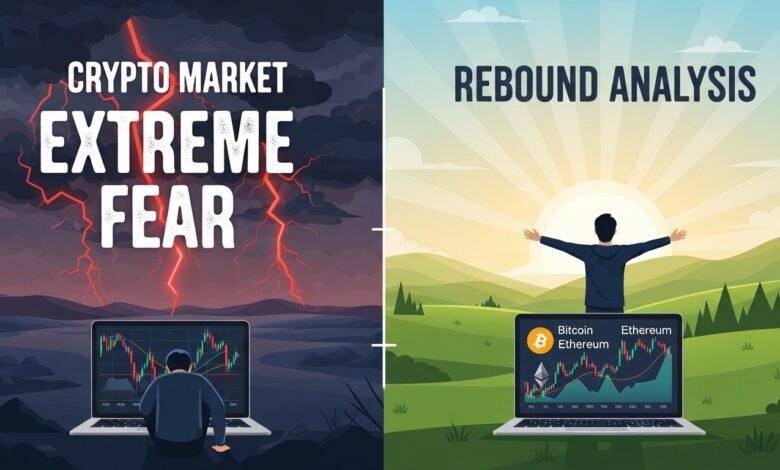
The crypto market’s extreme fear sentiment continues to grip investors even as major cryptocurrencies show signs of recovery. Despite Bitcoin and Ethereum experiencing notable price rebounds in recent trading sessions, the Fear and Greed Index remains firmly planted in extreme fear territory, revealing a stark disconnect between market psychology and actual price action. This paradoxical situation has left many traders wondering whether the current recovery represents a genuine reversal or simply a temporary relief rally before further declines.
Understanding the dynamics behind this crypto market extreme fear phenomenon is crucial for investors navigating today’s volatile digital asset landscape. The cryptocurrency market has always been characterized by dramatic swings in both price and sentiment, but the current situation presents unique challenges and opportunities that demand careful analysis and strategic thinking.
Crypto Market Extreme Fear Phenomenon
The crypto market’s extreme fear environment didn’t emerge overnight. It’s the culmination of multiple converging factors that have systematically eroded investor confidence over recent months. The Fear and Greed Index, a widely followed metric that measures market sentiment on a scale from zero to one hundred, has been hovering in the extreme fear zone, typically registering readings below twenty-five.
This persistent negative sentiment reflects deep-seated concerns about regulatory crackdowns, macroeconomic headwinds, and the lingering aftereffects of high-profile industry failures. When investors experience cryptocurrency market fear, they tend to adopt a risk-off approach, moving capital to safer assets or staying on the sidelines entirely. However, seasoned traders know that extreme fear often coincides with compelling buying opportunities, as assets become undervalued relative to their fundamental worth.
The psychological component of crypto market extreme fear cannot be underestimated. Fear is a powerful emotion that clouds rational decision-making, causing investors to sell quality assets at depressed prices or miss opportunities for strategic accumulation. This emotional contagion spreads rapidly through social media channels and trading communities, amplifying the overall sense of panic and uncertainty.
Bitcoin’s Resilient Rebound Amid Market Pessimism
Bitcoin has demonstrated remarkable resilience in the face of overwhelming crypto market extreme fear. The flagship cryptocurrency has managed to climb from recent lows, recapturing key psychological price levels despite the prevailing negative sentiment. This price action suggests that institutional investors and long-term holders maintain confidence in Bitcoin’s fundamental value proposition as digital gold and a hedge against monetary inflation.
The Bitcoin price rebound has been characterized by steady accumulation rather than explosive upward momentum. On-chain data reveals that long-term holders have been accumulating Bitcoin throughout the downturn, recognizing the historical pattern where extreme fear creates exceptional entry points. Whale addresses holding significant Bitcoin quantities have increased their positions, signaling confidence from sophisticated market participants.
Technical analysis of Bitcoin’s recent performance shows the cryptocurrency defending critical support levels that have historically marked major market bottoms. The digital currency fear index may indicate extreme pessimism, but Bitcoin’s price structure suggests that smart money is positioning for the next major uptrend. Trading volumes during the rebound have been substantial, indicating genuine buying interest rather than low-liquidity price manipulation.
Ethereum’s Recovery Despite Negative Sentiment
Ethereum has followed a similar trajectory to Bitcoin, mounting an impressive recovery while the crypto market extreme fear persists. The second-largest cryptocurrency by market capitalization has benefited from ongoing network developments, including improvements to scalability and transaction efficiency. These fundamental advancements provide a solid foundation for Ethereum’s value proposition beyond mere speculation.
The Ethereum rebound has been particularly noteworthy given the additional challenges facing the platform, including intense competition from alternative Layer 1 blockchains. Despite this competitive pressure and the broader cryptocurrency fear sentiment, Ethereum has maintained its position as the dominant platform for decentralized applications, non-fungible tokens, and decentralized finance protocols.
Network activity metrics for Ethereum reveal consistent usage and development activity, contradicting the narrative suggested by extreme fear readings. Daily active addresses, transaction counts, and total value locked in DeFi protocols have remained robust, demonstrating that the Ethereum ecosystem continues to provide real utility regardless of short-term price fluctuations and sentiment swings.
What’s Driving the Persistent Crypto Market Extreme Fear
Several interconnected factors continue fueling the crypto market extreme fear even as prices recover. Regulatory uncertainty remains perhaps the most significant concern, with governments worldwide grappling with how to classify and regulate digital assets. Recent enforcement actions and proposed legislation have created anxiety about the future regulatory landscape, particularly regarding centralized exchanges and stablecoin issuers.
Macroeconomic conditions have also contributed substantially to the extreme fear in crypto markets. Rising interest rates, persistent inflation concerns, and recession fears have driven investors toward traditional safe-haven assets. The correlation between cryptocurrency prices and traditional risk assets like technology stocks has intensified this dynamic, as crypto markets respond to the same macro forces affecting equities.
The memory of recent industry collapses continues casting a long shadow over investor confidence. High-profile bankruptcies and fraud cases have shaken trust in centralized platforms and intermediaries. This crypto investor fear extends beyond specific platforms to create generalized skepticism about the entire industry’s stability and trustworthiness, making recovery of sentiment a slow and difficult process.
Historical Patterns: When Fear Signals Opportunity
Examining historical crypto market extreme fear episodes reveals consistent patterns that savvy investors have learned to exploit. Previous instances when the Fear and Greed Index plunged into extreme fear territory often coincided with or immediately preceded significant market bottoms. The most profitable investment opportunities in cryptocurrency history have frequently emerged when fear was at its peak and the consensus view was overwhelmingly pessimistic.
During the 2018 bear market, crypto market fear reached similar extremes as prices collapsed following the 2017 bull run. Investors who maintained discipline and accumulated quality assets during that period of maximum pessimism were rewarded handsomely during the subsequent recovery. The same pattern repeated during the March 2020 crash, when pandemic fears drove cryptocurrency prices to temporary lows before a massive rally commenced.
The current cryptocurrency market extreme fear environment may represent a similar inflection point, where patient capital deployment could yield substantial long-term returns. Contrarian investors recognize that when everyone is fearful, assets often trade below their intrinsic value, creating asymmetric risk-reward profiles. The key challenge lies in distinguishing between temporary fear-driven dislocations and fundamental deterioration in asset quality.
Technical Analysis: Reading the Market Beyond Sentiment
While the crypto market extreme fear dominates headlines and social media discourse, technical analysis provides a more nuanced perspective on actual market conditions. Bitcoin’s recent price action has formed potentially bullish patterns on multiple timeframes, including higher lows that suggest accumulation despite negative sentiment. Key moving averages are beginning to flatten after extended downtrends, potentially signaling exhaustion of selling pressure.
Support and resistance levels have taken on increased significance in the current crypto fear market environment. Bitcoin has successfully defended critical support zones multiple times, indicating strong underlying demand at these price levels. Each successful defense of support builds a foundation for potential upside moves, even if broader sentiment remains negative.
Volume analysis reveals interesting dynamics beneath the surface of extreme crypto market fear. While retail selling has been pronounced, institutional accumulation appears to be offsetting this selling pressure. On-chain metrics show large transactions increasing during price dips, suggesting that sophisticated players are using fear-driven selloffs as accumulation opportunities rather than joining the exodus.
The Role of Institutional Investors in Current Market Dynamics
Institutional participation has fundamentally altered how crypto market extreme fear manifests and resolves. Unlike previous market cycles dominated by retail traders, current market structure includes significant institutional capital from hedge funds, family offices, and even corporate treasuries. These sophisticated investors typically have longer time horizons and employ more rigorous analytical frameworks than retail participants.
The cryptocurrency institutional investment narrative continues developing despite negative sentiment. Major financial institutions have launched or expanded cryptocurrency trading desks, custody solutions, and investment products. This infrastructure development proceeds regardless of short-term crypto market fear, suggesting that institutional conviction extends beyond momentum-driven speculation.
Institutional investors often view extreme fear crypto market conditions as strategic entry points rather than signals to exit. Their approach to risk management and portfolio construction differs substantially from retail traders, allowing them to maintain positions through volatility that shakes out less capitalized participants. This institutional accumulation during fear-driven selloffs helps establish price floors and supports eventual recoveries.
Regulatory Landscape and Its Impact on Market Fear
Regulatory developments remain central to the crypto market extreme fear narrative. Governments worldwide are implementing comprehensive frameworks for digital asset regulation, creating uncertainty about how rules will affect various aspects of the cryptocurrency ecosystem. The United States Securities and Exchange Commission has taken an increasingly aggressive enforcement posture, targeting projects and platforms it deems to be operating outside existing securities laws.
European Union regulatory initiatives, including the Markets in Crypto-Assets regulation, represent attempts to create comprehensive frameworks balancing innovation with consumer protection. While regulatory clarity could ultimately reduce cryptocurrency regulatory fear, the transition period creates uncertainty that amplifies negative sentiment. Market participants worry about compliance costs, operational restrictions, and potential enforcement actions against existing business models.
Asian markets face their own regulatory challenges contributing to global crypto fear. China’s continued prohibition of cryptocurrency trading and mining has shifted industry activity to more permissive jurisdictions, while other nations navigate between fostering innovation and protecting consumers. This fragmented regulatory landscape creates compliance complexity for global platforms and adds to overall market uncertainty.
DeFi and NFT Markets During the Fear Period
Decentralized finance protocols have experienced their own challenges during this crypto market extreme fear phase, but some projects have demonstrated remarkable resilience. Total value locked across DeFi protocols has declined from peak levels, yet core platforms continue processing billions in daily transaction volume. Users seeking yield and financial services outside traditional banking systems continue finding value in DeFi applications despite broader market pessimism.
The DeFi market fear has been particularly acute for newer protocols and those with questionable tokenomics, while established platforms with proven track records have maintained user bases and activity levels. Lending protocols, decentralized exchanges, and liquid staking platforms continue providing essential financial infrastructure regardless of sentiment fluctuations.
Non-fungible token markets have contracted significantly during the extreme fear period, with trading volumes and floor prices declining across major collections. However, utility-focused NFT projects tied to gaming, digital identity, and real-world assets have weathered the storm better than speculative collectibles. This divergence suggests market maturation, where projects with genuine use cases survive sentiment-driven downturns while purely speculative ventures struggle.
Mining Economics and Network Security
Bitcoin and Ethereum mining economics provide important insights into fundamental network health during crypto market extreme fear periods. Bitcoin’s hashrate, a measure of computational power securing the network, has remained near all-time highs despite price declines and negative sentiment. This demonstrates miner confidence in long-term profitability and commitment to network security.
The transition of Ethereum to proof-of-stake has created different dynamics for network security. Staked Ethereum quantities continue increasing, indicating that investors are willing to lock up their holdings long-term despite cryptocurrency market fear. This staking participation provides yield for holders while strengthening network security, creating positive feedback loops that support fundamental value.
Mining difficulty adjustments in Bitcoin respond to hashrate changes, ensuring block production remains consistent regardless of participation levels. During previous extreme fear crypto episodes, mining difficulty sometimes declined as less efficient operations shut down, only to recover as conditions improved. Current difficulty levels suggest that professional mining operations maintain confidence in Bitcoin’s long-term value proposition.
Global Economic Factors Influencing Crypto Fear
The crypto market extreme fear cannot be separated from broader macroeconomic conditions affecting all financial markets. Central bank monetary policies, particularly from the Federal Reserve, European Central Bank, and Bank of Japan, directly impact cryptocurrency valuations through their effects on liquidity conditions and risk appetite. Interest rate policies influence the opportunity cost of holding non-yielding assets like Bitcoin, affecting investment flows.
Inflation dynamics create competing narratives for cryptocurrency valuations. While Bitcoin’s fixed supply makes it theoretically attractive as an inflation hedge, rising prices often prompt central bank tightening that reduces liquidity and pressures risk assets. This tension between long-term inflation hedge properties and short-term liquidity sensitivity contributes to crypto investor uncertainty during periods of macroeconomic transition.
Geopolitical tensions and economic instability in various regions sometimes drive cryptocurrency adoption fear among potential users even while creating use cases for censorship-resistant money. Banking system instability, currency devaluation, and capital controls in certain countries highlight cryptocurrency utility, but global risk-off sentiment can overwhelm these localized drivers in the short term.
Trading Strategies During Extreme Fear Periods
Navigating crypto market extreme fear requires disciplined strategies that account for elevated volatility and unpredictable price movements. Dollar-cost averaging allows investors to accumulate positions systematically without attempting to time exact bottoms, reducing the psychological burden of buying into falling markets. This approach has historically rewarded patient capital deployed during maximum pessimism phases.
Risk management becomes paramount when trading during crypto fear episodes. Position sizing appropriate to individual risk tolerance helps investors survive volatility without forced liquidations. Setting stop-losses and taking partial profits at resistance levels allows participation in potential upside while limiting downside exposure if recoveries prove temporary.
Contrarian investors often find the best opportunities during extreme cryptocurrency fear by identifying quality projects trading at substantial discounts to fundamental value. This requires thorough research distinguishing between temporarily undervalued assets and fundamentally broken projects. Assets with strong development teams, real user adoption, and sustainable tokenomics deserve consideration even when overall sentiment is negative.
The Psychology of Market Fear and Recovery
Understanding investor psychology during crypto market extreme fear helps explain seemingly irrational price movements and sentiment disconnects. Fear triggers primitive survival instincts that override rational analysis, causing investors to prioritize avoiding losses over capturing gains. This psychological bias leads to panic selling near market bottoms, creating opportunities for those who maintain emotional discipline.
The transition from extreme fear to neutral or greedy sentiment rarely occurs overnight. Recovery typically follows a gradual process as negative catalysts fade and positive developments accumulate. Early stages of recovery often face skepticism from investors burned by previous false starts, creating resistance to accepting that conditions have genuinely improved.
Social media amplification intensifies crypto fear psychology as negative narratives spread rapidly through trading communities. Echo chambers reinforce pessimistic views, making it difficult for alternative perspectives to gain traction. Investors who diversify information sources and maintain independent analytical frameworks position themselves better to identify inflection points when fear peaks.
Future Outlook: When Might Fear Sentiment Shift
Predicting exactly when the crypto market’s extreme fear will transition to more neutral or optimistic sentiment proves challenging, but certain catalysts could accelerate sentiment improvement. Regulatory clarity from major jurisdictions would remove significant uncertainty, potentially allowing institutional capital sitting on the sidelines to enter the market. Positive regulatory developments have historically triggered substantial rallies in cryptocurrency prices.
Macroeconomic conditions shifting toward easier monetary policy could provide tailwinds for the cryptocurrency market recovery from extreme fear. If central banks pause or reverse tightening cycles in response to slowing economic growth, increased liquidity would likely benefit risk assets, including cryptocurrencies. However, the timing and magnitude of potential policy shifts remain highly uncertain.
Technological developments and adoption milestones could gradually shift sentiment away from extreme crypto fear toward recognition of fundamental value creation. Successful implementation of scaling solutions, growing institutional adoption, and expanding real-world use cases build the foundation for sustained appreciation beyond sentiment-driven volatility.
Conclusion
The crypto market’s extreme fear environment persists despite Bitcoin and Ethereum price rebounds, creating a complex landscape for investors to navigate. Historical analysis suggests that extreme fear often coincides with attractive entry points for long-term investors, though timing exact bottoms remains impossible. The disconnect between negative sentiment and recovering prices indicates that smart money may be accumulating while retail investors remain paralyzed by pessimism.
Successful navigation of cryptocurrency extreme fear periods requires combining technical analysis, fundamental research, and psychological discipline. Investors who maintain rational decision-making frameworks, employ appropriate risk management, and focus on long-term value creation position themselves to benefit when sentiment eventually improves. The current environment tests patience and conviction, but those qualities have historically been rewarded in cryptocurrency markets.
Whether the crypto market extreme fear represents a final capitulation before sustained recovery or a temporary pause in a longer downturn remains to be seen. What’s certain is that cryptocurrencies continue developing as an asset class, with improving infrastructure, growing adoption, and maturing market structure. Investors who educate themselves thoroughly, invest only what they can afford to lose, and maintain disciplined strategies will be best positioned to navigate whatever comes next in this dynamic and evolving market.
SEE MORE: Bitcoin Price Faces $80K Support Test Amid Market Volatility